Showing posts with label music. Show all posts
Showing posts with label music. Show all posts
Saturday, December 31, 2011


Monday, September 26, 2011
Lowell Folk Festival 2011
The Lowell Folk Festival was held once again in Lowell, MA on July 30, 31. We ended up going on Sunday and met J and Jennifer there. There is always, always, always something interesting going on and new music to discover. Past groups I first heard at Lowell were the likes of Hot Club of Cowtown, Sierra Hull, Kekele, John Doyle and Liz Carroll, La Vent du Nord, James Hand, and a few I've forgotten (which is why I write these things down!)
This year there were a few groups I had already heard of that I wanted to see. It's always hard to plan the schedule...I did hear a bunch of the groups on Saturday on WGBH radio, so some I was okay with missing.
First up was the fiddle traditions workshop with Michael Cleveland (bluegrass), the Quebe Sisters (Texas Swing), and guys from La Vent Du Nord (quebecois) and Dervish (celtic). This was really interesting because they went around and took turns playing songs in their own style. They also played together on a few common tunes that cut across the traditions.

Here's the list I wrote down:
After that, we went to Boardinghouse Park for the Birmingham Sunlight, a gospel group, who were sensational. Very engaging group.


Next up on the same stage was Michael Cleveland and Flamekeeper. They played some hot bluegrass, including his signature tunes - Orange Blossom Special ("a guitar player killer") and Jerusalem Ridge by Bill Monroe (J and I are tackling that one next...). He did that one as a duet with the mandolin player. I'd seen him do it like that at the Joe Val Festival earlier in the year - very exciting and fast.

 As you can see, we were right up close, which is usually not possible at Boardinghouse Park. Maybe it was because we usually go on Saturday but this time was on Sunday = less people there = more space for us! Yay!
This band is really tight and I immediately went home to pick up their new album, called "Fired Up!" but pronounced "Fahrd up" of course. The guitar player does most of the singing and is a fine singer, indeed. They also seemed very humble and genuine, even thanking their festival handler and playing a song dedicated to her. Sounds like they treat the artists right at this one.
After this set, we wandered over to the dance tent to check out the zydeco, but no one was really into dancing anyway, so we moved on to Eddie Pennington (and his son). I'd seen him before at Lowell and since I've been known to do a little finger-pickin' this appealed to me. (Plus, it turns out his guitar is a rare Henderson!) He seemed to be tired to me and kinda mailing it in. Just my impression...that was at the small Market Stage, then we moved on to the Kennedy Plaza for some Quebecois!


This year there were a few groups I had already heard of that I wanted to see. It's always hard to plan the schedule...I did hear a bunch of the groups on Saturday on WGBH radio, so some I was okay with missing.
First up was the fiddle traditions workshop with Michael Cleveland (bluegrass), the Quebe Sisters (Texas Swing), and guys from La Vent Du Nord (quebecois) and Dervish (celtic). This was really interesting because they went around and took turns playing songs in their own style. They also played together on a few common tunes that cut across the traditions.

Here's the list I wrote down:
- Yellow Rose Waltz
- Sally Goodin
- Fisher's Hornpipe
- Yearning
- Flatbush Waltz
- Sweet Georgia Brown
- St. Anne's Reel (and we were at St Anne's Church!)
After that, we went to Boardinghouse Park for the Birmingham Sunlight, a gospel group, who were sensational. Very engaging group.


Next up on the same stage was Michael Cleveland and Flamekeeper. They played some hot bluegrass, including his signature tunes - Orange Blossom Special ("a guitar player killer") and Jerusalem Ridge by Bill Monroe (J and I are tackling that one next...). He did that one as a duet with the mandolin player. I'd seen him do it like that at the Joe Val Festival earlier in the year - very exciting and fast.


This band is really tight and I immediately went home to pick up their new album, called "Fired Up!" but pronounced "Fahrd up" of course. The guitar player does most of the singing and is a fine singer, indeed. They also seemed very humble and genuine, even thanking their festival handler and playing a song dedicated to her. Sounds like they treat the artists right at this one.
After this set, we wandered over to the dance tent to check out the zydeco, but no one was really into dancing anyway, so we moved on to Eddie Pennington (and his son). I'd seen him before at Lowell and since I've been known to do a little finger-pickin' this appealed to me. (Plus, it turns out his guitar is a rare Henderson!) He seemed to be tired to me and kinda mailing it in. Just my impression...that was at the small Market Stage, then we moved on to the Kennedy Plaza for some Quebecois!

Le Vent du Nord was next. I saw them last year and really enjoyed it. It's a fun group, and they were even on the opening of Prairie Home Companion last weekend!! JFK Plaza is an awful place, similar to Boston City Hall Plaza, only smaller. All concrete and sun! Anyway, lots of people were dancing and they were joined at the end by the Irish band Dervish for some numbers, which was fun. And yes, it was hot, too, at the end of a long weekend of music.


Until next year at Lowell....
Yours truly,
Chris
Sunday, June 19, 2011
Splinters at IBM Centennial Celebration
As previously tweeted and facebooked, J and I played at the IBM Centennial Celebration at the Museum of Science. Both of us being IBMers made it convenient, for sure. The event was an "IBM's Got Talent" show with about 10 acts, ranging from rock and bluegrass to show tunes and dance numbers. I especially enjoyed the Indian dances - one traditional and one Bollywood style. (Somehow I ended up without a program, so I don't have all the details!)
Each performer had 4 minutes to get it done. This required quite a bit of editing on everyone's part. That was a common comment backstage, for sure. For our part, we decided to string together 2 fiddle tunes: Salt Creek followed by Whiskey Before Breakfast. We did the math and as long as the tempo was right, we'd be about 4:15. :) I guess it makes you focus and get to the point to have a time constraint.
We were fourth on the program, which was good - right after the solo singer doing "Memories" from Cats. After us was one of the Indian dances. The venue was the Cahners Theatre, which holds about 300 people. It was standing room only in there, maybe because there was no alcohol served at the party! Anyway, in addition, they also simulcast the show to screens throughout the museum.
Bottom line: we had fun and we nailed the transition to our satisfaction. One of J's colleagues took a video on his iphone and posted it to Vimeo.
The Splinters at the Boston IBM Centennial Celebration from Paul Beaulieu on Vimeo.
Chris
Saturday, June 04, 2011
The Splinters Live
J Johnson and I have been hanging out in my basement for a while shedding fiddle tunes. We debuted at the West Roxbury Open Mike night and have played at Roslindale too. One of these days, we'll get more than 2 songs to play at a real gig. :) We typically include some form of improvisation after playing the melody a few times; and it's fun to trade 4's back and forth.

We're making our way through the bluegrass top 20 tunes like:
We have been influenced by Doc Watson, Norman Blake, Tony Rice, David Grisman, Chris Thile, Bill Frisell, and Frank Zappa, among others.
We put up a web site under The Splinters name. Check it out to listen to some of the basement tapes.
Chris

We're making our way through the bluegrass top 20 tunes like:
- St. Anne's Reel
- Salt Creek
- Red Haired Boy
- Billy in the Lowground
- Whiskey Before Breakfast
- Cherokee Shuffle
- E.M.D.
- Blackberry Blossom
- Arkansas Traveler
- Soldier's Joy
- Temperance Reel
- Prisoner's Waltz (from Tone Poems 1)
- I Am Pilgrim
- Shady Grove
We have been influenced by Doc Watson, Norman Blake, Tony Rice, David Grisman, Chris Thile, Bill Frisell, and Frank Zappa, among others.
We put up a web site under The Splinters name. Check it out to listen to some of the basement tapes.
Chris
Sunday, May 29, 2011
Thile-Daves at Brighton Music Hall, Boston
 On May 24, J and I went to see Chris Thile and Michael Daves at the Brighton Music Hall in Boston - actually in the neighborhood called Brighton on Brighton Ave and Harvard Ave. I'd never been to this place before; I think in previous incarnations it was a metal-band venue, or at least rock and roll, known as Harper's Ferry. I don't think folk/bluegrass artists are necessarily on the bill all the time even now. However, we got there about 8:10 for a 9 p.m. show and got a great spot right up front and center as you can see from the photo I took to the right. It's a "standing room"; meaning, no seats to speak of and the sold out show of 340 eventually filled the hall. I think there are as many bars as there are seats: 3.
The stage looks relatively small for a band that has more than 3-4 people. Of course, that didn't matter on this night, as the setup was a single microphone in the center. The sound was great, especially being so close, you could hear both the amplification over our heads and the acoustic sounds coming out in front.
 As expected, they played a lot of tunes from their recent debut album, Sleep with One Eye Open. You can also hear a few songs on the official web site, but you'll want to just buy the album. I was busy writing down the tunes in Evernote for later, but at the end I took a picture of the set lists that some folks snagged from the stage. First set is to the left. The opening number, Evening Prayer Blues, was a short, quiet instrumental that set the stage for what was to follow. It was appropriate that Bill Monroe made this one famous, as you could hear that influence in both the playing and singing.
Chris Thile is an engaging performer and very comfortable up there, while Michael Daves seems more reserved. Both play with passion and fire! Their voices are well-matched, to the point where sometimes I could not tell who was singing which part, and I was standing right in front of them. The playing was superb - this is why you go see live music - you get the spontaneity and humanity that only comes from a live performance. You could definitely see, as well as hear, how they communicated on stage and in the moment.
Check out this video of the first set fiddle tune request that someone was kind enough to post on youtube. It was pretty funny to watch them get requests from the audience, then choose a sequence and key for each one...and then play their asses off (I can say that on the web, right?). "Freebird has words, and is therefore: DISqualified!" The reference to 7 strings and all the tuning was about Thile breaking a string in the middle of the set, which he repeated in the second set too.
Okay - that was amazing! :) You could hear both the tradition and taking it to the next step. They must have played these tunes a million times to get to the point of turning them inside-out. They did the same thing with the second set fiddle tune request time, but took Arkansas Traveler even further "outside". Check it out below about 2 minutes in. That deserves an OMG.
Speaking of live performances, they flubbed the transition from Camptown to Rebecca, which was going from key of Bb to B (of all things). Oops. In the video, you can see Daves trying to make the eye contact to signal it was coming. They made up with it afterwards by trying just that part - so we got to see the live rehearsal process, too. See below - pretty cool. I still can't believe they played that tune in B - who does that on purpose??
"Wasn't that cooool????"
You should really listen to some of the tunes with singing - it's as big a part of the experience as the instrumentals. "Loneliness and Desperation" is a good example of how it can cook. It reminds me of early rock and roll feel, foot-tappin' music....or maybe even foot-stompin'!
 Finally, for completeness of the historical record, I present to you the second set list. Enjoy and go see some live music, people. Where else will you see the performers whip out a bottle of rye and start swigging it during the encores? And if you get a chance to see these two perform this summer, go for it!
All in all, both J and I were inspired by this performance and took some of it to the practice shed last week, as we forge our own identity on guitar/mando. I hope some of it rubs off on us.
Note to Thile/Daves: next time play at Passim - at least we can sit down.
Chris
P.S. Thile's other band, Punch Brothers, is playing at the Lowell Summer Music series in August. There's other great music there too.
P.P.S. We ate at the Sunset Grille, but don't go there for the food. They do have 112 beers on tap however. Unless they are out of some, then there are 110.
Sunday, April 24, 2011
Julian Lage at Club Passim

I was browsing through the Boston Phoenix paper yesterday and saw that Julian Lage was playing at Club Passim. How did I miss this? Anyway, I went to the Passim website and there was only 1 ticket left for the 7 pm show, so I snagged it. (I didn't realize until later that he was playing a 10 pm show as well as Sunday night at 8 - the front page of the site only listed the 7 pm show!)
Anyhoooo...on with the show. I arrived at 6:40, having secured my usual secret free-parking space near Harvard Square. Club Passim, or as most people call it, Passims, is a basement venue in Harvard Square. Mostly they have folkie acts, so having a jazzer appear was a bit unusual. It's a great place to hear music because 1) it is quite, um, 'intimate', meaning that you are practically sitting not only on the person next to you, but also on top of the performers; adn 2) the sound is really good - not too loud and a mix where you can actually hear everything. Add to that, the aforementioned intimacy, where you can hear the acoustic nature of the instruments blending with the sound system, and it makes for a good room.

The Julian Lage Group this time is a quintet, adding a cello and tenor sax to the usual guitar, bass, drums trio that I saw at the Beantown Jazz Festival in Sept. You can see how crammed they are on the tiny stage. This was the CD Release party for Gladwell, available on April 26, although they had them at the show. They played a lot from that album, as far as I could tell. The show was excellent and ran from about 7:10, aka "jazztime" to 9 pm.
I'm pretty sure the opening number was "Listening Walk" from Gladwell, due out on April 26. Talk about a workout on the left hand! No wonder at the end of the night Julian said that he's been having to take care of his left hand due to overuse (I can relate, but he's only in his 20s!). For the most part the cello and sax were a calming counterpoint to the frenetic picking and percussion of that tune; they seemed to play that background role quite a bit throughout the concert - more like texture backing the trio rather than being on equal footing as soloists on every song. They did get some extended solo turns later in the set. I liked the way it worked. The band was tight, able to shift on a moment's notice from loud to soft, from quiet introspection to frenetic jam - this is the stuff that makes for a great night of music making.
Other tunes they played from Gladwell included However, Cocoon, Telegram, and probably more, but I'm just judging by the clips on amazon.com and what I remember. :) I can hear in his playing a ton of influences as well as his own unique voice. Sometimes, I hear the Pat Metheny lick or harmony, but he doesn't stay there long. Like Metheny, it sounds modern and rooted in tradition at the same time - whether that tradition is jazz, rock, folk, country, or something else...I think it's all of those. Just watch some of the videos on his site or youtube and you can also see that he is really having a good time. Having complete command of your instrument doesn't hurt, either.
Speaking of tradition, the trio did one of their trademark tunes, the standard Lil Darlin'. This was not your typical Berklee practice room jam session! Go listen to Joe Pass play it first (or this big band arrangement is good and unctious). Then come back and listen to this version (coincidentally recorded at Passims last Aug). Hear the difference? That's how you modernize a classic and make it your own. At one point, Julian played a new song he was working on where he said he wanted to make something like a traditional jazz tune, but also make fun of it. Making fun of it isn't exactly what he meant; I think it was more about being ironic. Maybe it was just taking a traditional form and extending it for the 21st century - yeah, I'm going with that last one. :)
That video of Lil Darlin' kinda sums up the group aesthetic. The tune is a jumping off point for an extended improvisation. The interplay among the musicians is awesome, as they almost go into a free jazz section for an extended period before bringing it back home. You can do that if you 1)know the tune inside out; 2) have chops for days; and 3) listen closely to what is going on in the moment.
You can also see in that last video the unusual technique of the percussionist, Tupac Mantilla - using mostly his hands to play. Last night when they played Lil Darlin, he stood up and mostly played by clapping, snapping fingers, hitting himself in various places (knees, face, chest, etc) and even reached over the drum set to bang on the bass for a bit (and on the bass player too, for that matter).

The encore number was, in his words, "well, you'll know what it is" - i.e. Freight Train. The first part was the way I learned it, but not after that!! His right-hand technique is something to behold on this one, as he played with a pick and was all over the strings with ease.
A great ending to a spectacular night of music.
P.S. That guitar he plays is a Linda Manzer "Blue Note" that he's had since he was 11 yrs. old. There was an article in the Fretboard Journal about him I read again last night. It can sound really acoustic or really electric depending on how he plays it. He does set up with both a Fender Twin amp (I believe) and a mic in front to get the acoustic sound.
Monday, August 02, 2010
Lowell Folk Festival 2010
On Saturday, July 24, we met our friends Dave and Lisa at the Lowell Folk Festival, a free 2 day event in the old mill town of Lowell, MA. The setting is very nice, in the middle of the oldest part of the city surrounded by the long-gone manufacturing buildings of the industrial age and the workers' dormitories. They spun a lot of cotton in Lowell back in the day....it's surrounded by canals that were built to harness the Merrimack River.
It was an extremely hot and humid day, about 92 F. Our first stop of the day, conveniently located right outside the Market St. garage, was the Quebecois band, De Temps Antan. Just 3 guys, but what a big sound. The picture below shows them cranking out a tune on fiddle, harmonica (chromatic style), and guitar. The harmonic player also played accordion. I think they could play the same tune for hours, getting to a fever pitch before stopping on a dime. You'll notice in the picture that the fiddle and guitar player are sitting down. That's so they could tap with their feet the rhythm of the tune as they played. It really added some depth and drive to the music, which I find to be a weird blend of Cajun, French, and Irish, but which they would probably just call Quebecois. The guys are native French (Canadian) speakers, but also spoke English to the crowd and were quite engaging. We caught them on the big stage later in the day, too.

(you can see more pics in my picasa web album)
The great thing about Lowell is that the crowds are pretty manageable. You can get right up close to the stage, the sound is great, and it is very relaxed. I never felt like I was overwhelmed with people, partially because the 5-6 stages are spread out and partially because I think a lot of people are on vacation....also, did I mention it was hot??!!
After this show, we met up with Dave and Lisa and headed over to JFK Plaza to see Steep Canyon Rangers (who backed up Steve Martin and did so at the Newport Fest just last weekend). The only problem with JFK is that there is absolutely no shade and it's all concrete/brick, which makes for extra baking. There are a lot of food stands here, so we grabbed some food (Greek, Laotian) while we were at it. The band was in suits and I really don't know who anyone could play in that weather, but they were awesome. It was too hot, so we moved on after a few tunes (they usually play 45 min sets anyway).(Guitar note: I do believe that was a Collings that guy was playing....:) )

Next up, we went to the amphitheater at Boarding House Park (so named because that's where the workers stayed, I guess). We listened to Bua, a young Irish group who were good, but didn't seem as dynamic as De Temps Antan. It's somewhat challenging to get a seat in this venue, so you have to wait for the changeover to go nab a seat, which we did. We listened to De Temps Antan again cuz our friends missed them the first time. I didn't mind. :)
Somewhere in there we checked out the Kings of Harmony shout band. The cool thing about Lowell is that the music is not just "folk", but also gospel, soul, reggae, bluegrass, armenian, egyptian, korean, and so on. We've always discovered new music here that is worth going home and buying for the collection (Kekele comes to mind...). This band was like gospel, New Orleans brass bands, and funk, all wrapped up in one! You had to get your feet moving (but I was tooooo hot to move much besides my hands). It was mostly trombones, with a couple of sousaphones and drums thrown in. They worked the crowd up big time. It was very joyous music.

The highlight of the festival was The Hot Club of Cowtown, an Austin, TX based trio doing a blend of Bob Wills and Django Reinhardt in their own style. I knew I wanted to see them after seeing their videos on Youtube. I couldn't believe what I was hearing!! Go check 'em out. They've made a bunch of records, too and I snagged their first and last ones from Amazon when I got back home. We saw them in the so-called Dance Pavilion, which is a tent with a dance floor. While some people were actually dancing, we just bulled our way to the front and sorta stood-danced (remember, it was hot and humid). It appeared to us that they didn't have a set list, but were just calling out tunes based on their mood and the crowd. I like that - it shows confidence in what you can do. Again, I don't see how they could play as well as they did with the heat/humidity. I got some good photos, too.
All three of the musicians were excellent and got ample solo time. The fiddle player, Elana, also sang...she always seemed to have a smile on her face. The bass player was slapping like crazy and driving it all forward. The guitar player was ripping off solos left and right!! It was spectacular, really. They even traded 4's at one point and seemed to really enjoy it. (Guitar note: looks like a Gibson 175 from the late 40s to me).

Hot Club of Cowtown

Slap that bass!

Play that fiddle!

Shred that guitar!
In between all this, there are food stands, crafts, and kids games throughout the venue. For example, there was a one-man-band dude, who made his own instruments.

Eric Royer, one man band dude.
And a guitar maker, William Cumpiano, showing off his Puerto Rican Cuatros. This is the same guy who wrote the guitar making bible!!

We finished off our day with dinner at a vegetarian restaurant, called Life Alive, which was quite good. I felt so healthy!!
All in all a fine day!
Chris
 |
| From Lowell Folk Festival 2010 |
(you can see more pics in my picasa web album)
The great thing about Lowell is that the crowds are pretty manageable. You can get right up close to the stage, the sound is great, and it is very relaxed. I never felt like I was overwhelmed with people, partially because the 5-6 stages are spread out and partially because I think a lot of people are on vacation....also, did I mention it was hot??!!
After this show, we met up with Dave and Lisa and headed over to JFK Plaza to see Steep Canyon Rangers (who backed up Steve Martin and did so at the Newport Fest just last weekend). The only problem with JFK is that there is absolutely no shade and it's all concrete/brick, which makes for extra baking. There are a lot of food stands here, so we grabbed some food (Greek, Laotian) while we were at it. The band was in suits and I really don't know who anyone could play in that weather, but they were awesome. It was too hot, so we moved on after a few tunes (they usually play 45 min sets anyway).(Guitar note: I do believe that was a Collings that guy was playing....:) )
Next up, we went to the amphitheater at Boarding House Park (so named because that's where the workers stayed, I guess). We listened to Bua, a young Irish group who were good, but didn't seem as dynamic as De Temps Antan. It's somewhat challenging to get a seat in this venue, so you have to wait for the changeover to go nab a seat, which we did. We listened to De Temps Antan again cuz our friends missed them the first time. I didn't mind. :)
Somewhere in there we checked out the Kings of Harmony shout band. The cool thing about Lowell is that the music is not just "folk", but also gospel, soul, reggae, bluegrass, armenian, egyptian, korean, and so on. We've always discovered new music here that is worth going home and buying for the collection (Kekele comes to mind...). This band was like gospel, New Orleans brass bands, and funk, all wrapped up in one! You had to get your feet moving (but I was tooooo hot to move much besides my hands). It was mostly trombones, with a couple of sousaphones and drums thrown in. They worked the crowd up big time. It was very joyous music.
The highlight of the festival was The Hot Club of Cowtown, an Austin, TX based trio doing a blend of Bob Wills and Django Reinhardt in their own style. I knew I wanted to see them after seeing their videos on Youtube. I couldn't believe what I was hearing!! Go check 'em out. They've made a bunch of records, too and I snagged their first and last ones from Amazon when I got back home. We saw them in the so-called Dance Pavilion, which is a tent with a dance floor. While some people were actually dancing, we just bulled our way to the front and sorta stood-danced (remember, it was hot and humid). It appeared to us that they didn't have a set list, but were just calling out tunes based on their mood and the crowd. I like that - it shows confidence in what you can do. Again, I don't see how they could play as well as they did with the heat/humidity. I got some good photos, too.
All three of the musicians were excellent and got ample solo time. The fiddle player, Elana, also sang...she always seemed to have a smile on her face. The bass player was slapping like crazy and driving it all forward. The guitar player was ripping off solos left and right!! It was spectacular, really. They even traded 4's at one point and seemed to really enjoy it. (Guitar note: looks like a Gibson 175 from the late 40s to me).
Hot Club of Cowtown
Slap that bass!
Play that fiddle!
Shred that guitar!
In between all this, there are food stands, crafts, and kids games throughout the venue. For example, there was a one-man-band dude, who made his own instruments.
Eric Royer, one man band dude.
And a guitar maker, William Cumpiano, showing off his Puerto Rican Cuatros. This is the same guy who wrote the guitar making bible!!
We finished off our day with dinner at a vegetarian restaurant, called Life Alive, which was quite good. I felt so healthy!!
All in all a fine day!
Chris
Saturday, June 12, 2010
Wayne and Chris Have Some Late Nights
 A couple of weeks ago my good friend, Wayne Goins, came back to Boston to visit the gang here. I first met Wayne at Camp Encore/Coda in Bridgton, ME in 1985(?) where we were both guitar instructors. Back then, he played a strat and his main guys were Hendrix and Prince and the blues. I was a pure jazzer with my Gibson ES-175 and Berklee degree. We got along instantly, talking guitars, playing 24x7, or on the basketball court.
Now...he's gone on to get his PhD (Dr. Goins!) and I'm at IBM. Wayne still has amazing chops and musicality, big ears, and a warm personality. Luckily, we got a chance to play while he was here. He borrowed my 175 and I never heard it sound so good...certainly not in my own hands! :) We got in some good times playing with Jamie Saltman, owner of the aforementioned Camp and a great pianist, too.
Wayne and I hung out a couple of late nights. The first night we stayed up until 3 am watching Wes Montgomery videos on youtube. We hadn't seen these before and there were even some where Wes was speaking ("this is not a perfect instrument") about how difficult it was to keep the guitar in tune. We decided he sounded like Quincy Jones. There's another one (End of a Love Affair) where he's teaching the piano player the tune in rehearsal - watch at the end where the pianist wants to take it up a notch, tempo-wise, and Wes is saying, "alright, let's go". Wes is so cool and effortless when he plays; the music just flows out of him like a spring, with endless ideas. He's often looking around, offstage or wherever, as he plays, just killin' it! He even stopped to light up a cigarette during the real take of that tune. :0 We kept trying to see how he was actually using his thumb so fast - it was like a butterfly on the strings.
On Memorial Day, we had a bbq at our house before heading over to Jamie's to play a little - this time, adding in renowned local musician, Bo Winniker, who also lives in the neighborhood and who's son just graduated in my son's class - small world dept. I thought we were just going to play through some standards for a few hours, but it turned into a real lesson! Bo had been talking at the bbq about a tune he's been "working on" for a few years (!) and called that one up first - The Dophin. I had seen this one in the Real Book, but never really stopped to play it. It's got some gnarly twists and turns in it. If I looked down off the page, then there was certainly danger of skipping a line and getting lost! We played that one for about 20 min, going around taking solos, feeling it out. There is a video of that one that I got, but it's too big to post.
The next one Bo called was "Airegin", by Sonny Rollins. Yet another one I hadn't played that much, but of course heard alot via Miles and Wes Montgomery. Well, we played that tune for an hour and 20 minutes straight! Deborah (Goins) got about an hour of it on video before it ran out. We just kept going around - Bo, Wayne, Jamie, me - one chorus at a time. I can tell you that I got pretty tired (on bass, no resting between solos) and was lucky that Wayne kicked in some rhythm when I was starting to drag - hehe. That tune is also pretty tricky in parts with the various II-Vs (which is why Wes loves that song, no doubt) cycling thru a few keys in rapid succession, but is fun to play. Bo (on trumpet and flugelhorn) sounds amazing - so tasty and smooth, soulful. It was a pleasure to hear him play this pure jazz.
Later on Wayne and I went back to my house to hang out and partake in some Hennessy(his new drink of choice). Funny that no one else wanted to go with us... Even though I was already tired from playing earlier, I wanted to play some more with Wayne, so we went to the basement and went through a couple or three tunes - a blues in G, Beautiful Love, and Someday My Prince Will Come. This time, I played the upright bass instead of electric, which is always more challenging for me since I hadn't played it that much in recent months and I'm out of shape on that physically demanding instrument - it's not something you can just pick up and play. I got my customary blister for the effort. I flipped on the Zoom H4n recorder and got some of it.
Blues in G - (click to load the mp3 in your browser) You'll hear how great Wayne is on this one!!
Beautiful Love - I've listened to Bill Evans play this tune about 4000 times, but haven't played it much, which is why I made Wayne play it with me.
Not sure if I want to post the last one yet..."Some day..." was interrupted by a phone call from one of his students.
Again, we stayed up til 3 am chatting and I spent the next day at work recovering. Allegedly there were a couple of empty Hennessey bottles found in the morning. (I blame Lucas.)
Chris
Saturday, May 15, 2010
Pat Martino - Scullers 2nd Set
I almost forgot that we had tickets to Pat Martino, until Mr. Johnson rang me up to confirm a meeting time. 10 pm set on a Friday is risky due to the lack of sleep during the week, but we went anyway. I'm glad I did! It was the first time I'd seen him and I don't think I ever listened to him too much, but obviously knew about him. He was playing his Benedetto signature model guitar, a solid body model with 2 pickups although he only used the front one.
Seating was general admission so we got a decent table a few "rows" back. It's a small club anyway, so not a bad seat in the house. The classic trio consisted of Pat, Tony Monaco (B3 organ) and Jason Brown(drums).
When they started to play, it was kind of a shock because the guitar was really loud and muddy - I always wonder whether the sound person has lost their hearing because it is so obviously wrong. Would it hurt to add a little treble into the mix?
The music itself was great! They came out smokin' with a boppish tune which I didn't know, followed by a blues which he seemed to call on the fly to the organ player (ah, just found that blues on youtube here), and a latin-ish tune. I think Blue in Green was next, with many liberties taken with the melody, but the signature tune intact.
The odd part of the night came when Pat called up his wife, whom he is clearly smitten with, to play 2 Wes Montgomery inspired songs with him - Heartstrings and Bock to Bock (also on a Derek Trucks album, btw). She's been playing "for a few years - 3 or 4, i think" and it looked like a student/master recital where the student plays some medium difficult chord changes while the master does his thing and makes it sound good....only in the first song, she couldn't find the beat to save her life. I just tried to concentrate on what Pat was doing instead.
Thankfully, the band returned and they killed another Wes Montgomery tune: 4 on 6. Tony Monaco is a sight! His facial expressions are priceless and animated - you could read the emotions (mostly joy) in his face and clearly he was enjoying himself at the B3 - relishing in the cheesiest sounds possible, then laying out a monster dissonant chord for emphasis. This was a highlight of the night for me.
They finished the night with Oleo, but it didn't seem like they were playing the standard thythm changes - I think it was more open than that (a la So What or Impressions) which gave the soloists more room to maneuver.
After the show, J somehow ran into Pat and shook his hand and gave him a few bows of worship. When we asked what his hand felt like, all he said was, "Boney."
Monday, September 28, 2009
Red Molly Concert

On Sept 26 we went to the Homegrown Coffeehouse, in Needham, MA at the UU church to see Red Molly, an excellent group who we saw the past summer at Club Passim. Before the show, we went to eat at Sweet Basil, around the corner, a place that does not take reservations! Therefore, while we were waiting the 20-30 minutes, we went over to the church to see if we had to pay or what (Emily had ordered tickets online awhile ago).
While trying to figure out where the entrance was (on the side), I saw one of the group (Abbie) in the window and gave her a vigorous wave, to which she replied with her own wave. Then we went in and up the stairs to see the place and Abby and Laurie came out and chatted us up a bit. The guy in charge let us go in and put our coats on some seats in the front, which was fortuitous because when we came back to go in there was a big line, even at 7:30. The church is so small that there really wasn't a bad seat.
Of course, I can't remember the entire set list...but at the end, when we went up to the stage to chat them up some more (J had questions about the dobro - a Scheerhorn Wechter - and I wanted to get a closer look at the acoustic bass guitar - a $400 Dean), they said they had 16 songs over the 2 sets. Some of the songs that they did were, in no particular order:
Caleb Meyer (first song - Abbie in lead)Summertime (by Carolann)Wayfaring StrangerA solo by CarolannLong Ride Home (Patty Griffin)The Mind of a Soldier (winner of the John Lennon songwriting contest)It's Good-bye and So Long to YouA Tim O'Brien learned song I don't know the name of...May I Suggest (a stunning a capella song that they did as an encore and in the center of the church with no mic's...a religious experience right there!)
Jud Caswell, of Brunswick, ME, opened the night with an excellent set. He sat down front without amplification to do "Blackberry Time", which made it all feel so cozy. He also came out in the middle of the Molly's set to sing the song that gave them their name, by Richard Thompson.
Red Molly comes up to the Boston area a few times a year, so make sure you go check them out when they do, before they get too famous and you won't be able to get close to them!
Chris
Saturday, August 01, 2009
New to Me Music
Here are a few recent discoveries in the collection:
Carrie Rodriguez - saw her on Austin City Limits and had to check it out further. Sounds modern and traditional at the same time. Interesting songs.
The Be Good Tanya's - I think they came up in an amazon.com list after looking at the Wailin' Jennys. Who knows? but they're good! They seem to be on leave at the moment.
Red Molly - We saw them at Club Passim in Cambridge recently and they are very entertaining and great musicians. They are still on tour.
Sara Watkins - Solo album. She of Nickel Creek, I enjoyed this one, too.
Bill Frisell - Disfarmer - new CD from Frisell written to accompany a photo exhibit by Arkansas portrait photographer Michael Disfarmer. You can hear it on NPR if you want. Another mix of new and old sounding music. Some of the stuff sounds like Phillip Glass and other like Hank Williams.
Marc Ribot - After reading an article in my favorite mag - Fretboard Journal - decided I needed to explore his music. Hard to pin down, depending on the setting, but I like the Cuban inspired band Los Cubanos Postizos and his solo guitar work, like on the Masada Guitars album, which also has Frisell on it. He's also worked with Tom Waits, Albert Ayler, and the Raising Sand album with Robert Plant and Alison Kraus.
Oldies but Goodies Dept.
Picked up some blasts from the past - Little Feat, Old and in the Way, It's a Beautiful Day, Pentangle, Mingus, Wes, Grisman, and Piazzola! Too many to mention and go into detail on, but a good mix to add to the collection.
I will mention one name, however, and that is Cal Collins, who I saw in Cincinnati quite a bit when I was there and is the most awesome jazz guitarist you never heard of. I had all his records and the digital versions are hard to come by. Luckily discovered some online, because they are not all available on CD or mp3.
That's it for now, check out this music now.
Chris
Monday, November 10, 2008
Vermont Instruments Guitar Building Course – Week 3
Note: This entry and others on this blog reflect my own personal experiences at Vermont Instruments, taught by George Morris, during the weeks of October 11 – November 1, 2008. I left out a lot of the details of the process in order to keep this shorter and more for a general audience. There are plenty of good references available on making a guitar and guess what? Everyone does it differently!
You might want to read these posts first:
Introduction
Week 1 – making the parts
Week 2 – assembling the parts
“It’s fine, it’s fine.” – Adam.
An important aspect of the course is that George and Adam build a guitar right alongside you. All of the demos that George did to teach us were done on this guitar. I think this is effective in showing us how it’s done before we go hacking away at our own pieces of wood. After all, none of us had done any major woodworking to this degree before. (I had built opera sets and props before, back in the 80’s.) It was indeed humbling to watch the masters go to work so effortlessly, then try to emulate it, stumbling along like a baby taking his first steps. Was it me? My unsharpened tools? My technique? It turns out that sharp tools are key and practice makes for better control over the tools. Some things you just have to experience in order to discover what works or doesn’t work. And while decisions are placed firmly into your novice hands, it’s always good to look over to how George is doing something to get an idea of the right way – no sense in making a rookie mistake when tradition has dictated certain proven methods.
They were building a Gibson style dreadnaught with some rosewood that Adam had been saving for the right moment. It was quite stunning! It also had a bound fretboard and ergonomic body depth shape so it’s easier to play, but retains the same volume of air being pushed through the body. You can see it in the pictures below.
Finish Week
Week 3. Day 15. The final push. So close, yet so far. And so on. This is the week to pull it altogether. We knew our end goal was to get strings on the guitar by the end of the week, but just thinking about everything that was left to do gave me a headache. It’s best not to think about it and just do it, I decided.
There was a lot of scraping and sanding going on in the shop as everyone took off the ropes holding the bindings on and began the process of cleaning up. We spent all morning on Monday doing that. It had to be done sometime.
The real goal was to get the fretboards (a.k.a. fingerboards) glued onto the neck. Most people had already cut their slots in the board during week 2 sometime, but I hadn’t yet. It was pretty straightforward using the jig and template for my scale (25.4” for those counting at home) and the table saw. Then you use the drill press to cut 2 mm holes for the side position marks, also known as “the dots”. After that, you needed to use your posterboard pattern (again) and masking tape to mark where to cut the board to the proper shape. Hopefully, you were careful about measuring it the first week when you made it.
Once you had cut the shape, it was ready to glue to the neck using a special caul and a bunch of clamps. For us bolt-on neck people, you could do it off the guitar body, then while that was drying you could continue to work on the body very easily. You use a very thin layer of white glue for this so it would be easier to remove if a repair person had to do it in the future. Or as George joked to me, “That repairman might just be you, tomorrow!” Doh! A few of us stayed late to finish the gluing, including me and Jon. I got out of there by 9 pm that night after putting another coat of tru-oil on the top.
The next step in preparing the fretboard for actual frets is to “radius it”. That means that there is a very subtle curve to the board, which increases the playability of the guitar, especially for bar chords on the first couple of frets. And just to make matters more interesting, it’s not the same curve throughout the fingerboard. The Morris standard goes from a 12 inch radius at the nut end (first fret) to 16 inches at the 20th fret. You use a plane to take off material at the edges, carefully and not too much! Then a sanding caul that has the proper radius built into it helps get it down to the exact fit.
After putting in any face dots that you might want to have, then you can install the fret wire. It took me a little over an hour to put in the 20 frets. I’m guessing you could get faster at it over time. It gets very noisy in the shop during this process, so put on the ear protection. After the glue dries, it’s a real pain to get it off the board using an x-acto knife and carefully scraping. Moral of story: don’t use too much glue and don’t be messy with it. Some people use super glue but we used tite-bond on the edges where the fretboard is curved and the place where frets would most likely want to pop out.
On Wednesday it was on to shaping the neck. I found this part to be most enjoyable, mainly because it worked out for me without a lot of angst. The method for turning a square chunk of mahogany into a nice playable neck was to mark out the desired shape onto your fretboard pattern at each end of the neck. At the end of the day, there’s pretty much nothing that is square on a guitar, it being all angles and curves. So the pattern will be different at each end as the fretboard widens toward the body. You start out with a circle and then modify from there, depending on whether you want a V-shape or a flatter neck. (The Martin is what they call a modified V, which is essentially a V on one side, from my understanding.) I just went with the standard roundness for my first guitar, although I like the feel of the Martins.
Once you have the neck shape on your paper pattern, and it’s been checked by George or Adam (there must have been some major errors at this step in the past for them to actually check your work), then you needed to transfer the same shape pattern to the actual wood. Again, you are working in 3-D, so you need to mark lines on both the bottom and side of the neck – this will determine where you will need to make your first facet cut in the neck. It’s probably hard to visualize through only words, so here are some pictures.
You re-measure and follow this same process 2 more times, at least, and eventually you end up with a neck that follows the curve that you determined on the pattern. Then, it’s a matter of sanding and integrating the main neck with the headstock and heel so there is one continuous feel to it. That actually took me longer to get right because you are transitioning from two different planes of wood. This pretty much took the whole day to do, but it wasn’t our only mission that day.
Before we could do any stringing of guitars, we needed to make and glue the bridge. Since this is where all the stress of the strings goes, you can’t mess around with it and it’s good to let it dry over night. Therefore, working back from Friday, we needed the bridge on by Thursday sometime. I think George wanted it on Wednesday, but we were too slow getting them cut out and sanded, ready for gluing. I was certainly in the shop until 11 p.m. finishing the bridge and adding another inlay of rosewood where the neck meets the body.
By 10 a.m. on Thursday, I had glued on my bridge. My rookie mistake of the day was to try to clean the glue off from around it using a spare wooden stick and poster board, which put some nasty scratches in the top. When I confessed to George, he said, “The perfect police will be by later today, too,” which made it seem not too bad, although I hate it when I do stuff like that.
While the bridge was drying, you could work on the fretboard and make your saddle and nut. This took most of the rest of the day. The idea was to get the frets themselves into playing shape by leveling them and filing them round. This is essential for playability and to prevent fret buzzing that will show up when the strings are on.
Meanwhile, Adam had set up the 2 tenor guitars that George had made that were hanging around the shop. One was walnut and one was mahogany. He also did some experimenting with different bracing on the back, using a lattice bracing on the walnut one. Oh, man, those little guys were loud!
Thursday night I spent more time in the shop. By this time, we knew what needed to be done to get to completion by Saturday. For one thing, my neck needed more work to make those transitions to the heel and headstock right. You need good definition at the headstock and while I was following the Martin style at the bottom, it just wasn’t well defined yet (or straight, for that matter!). I worked on that for awhile with a rasp to get it right and I’m glad I did.
I also cut out some the mother of pearl for my headstock inlay I had planned. I was the only one of the group who was going to attempt this and time was running out. I was determined to get this done, not only for aesthetics reasons, but simply to learn how to do it. More on that later… I got out of there by 10:30 p.m.
I can tell that Friday was a frenzy of activity, because I have absolutely zero notes in my notebook, except what we worked on that day. It was setup day. The next scary operation was to route the saddle channel into the bridge. This is done last so that you can make absolutely sure where it should be based on the perfect intonation. This accounts for any (ahem) “variation” that may have occurred during the building process. You simply cannot get it right any other way than to put on a temporary saddle, add some strings and move it around until it’s in the right place and in tune.
I couldn’t even start the intonation dance until I had checked that the neck was bolted on straight in all its variations. Fortunately, mine was perfect and I didn’t have to do a thing to it! Others with bolt-on necks were not as lucky. Lynn and Brennan had to work on removing minute areas of the neck, painstakingly, until they got it right. That is the problem with bolt-on necks – it took them literally hours of adjustment work before the neck was properly aligned and ready for the next step. I guess the good news is that now they are experts in that area, whereas I am not.
Finally, I could string my guitar up and actually hear it for the first time. Jon had already done his on Thursday. Adam walked me through each step. It’s very exciting. Everyone gathers around and wants to play it. We’ve been living with these pieces of wood for almost three weeks already, so hearing what they sound like is quite satisfying.
I must say that all of the guitars sounded loud and even across the full range of the instrument. The bass was resonant – I could really feel it in the body. The highs were ringing. I still can’t believe how good it sounds and how playable it is. I keep picking up one of the other guitars I have (the Martins or Collings) for comparison and to me, my new guitar compares favorably to those. Of course, fresh guitar will only get better over time and I can already hear it changing as it settles in. Time will tell.
Now that the strings were on, it was time to take it all apart again! There was more finish work to do. For instance, after getting the saddle intonation exactly right, you had to file it and sand it. Also, I still needed to do my inlay and get a first coat of tru-oil on the back and sides. However, there was certainly light at the end of the tunnel and I knew we would all have playable guitars from this adventure. I spent another night in the shop to finish cutting my inlay so I would be ready to do it on Saturday morning before the course was officially over. I think everyone was in the shop until about 10:30 p.m. doing various finishing activities.
On Saturday, I started the inlay process. It took me four hours, but I’m glad I did it for the experience – plus, it turned out really well. I can see why some folks don’t necessarily like to do the inlay part, although I enjoyed it. You use a jewelers saw to move the piece through the pattern you are cutting, keeping the saw moving up and down at a steady pace. It’s not hard to do, but it is time-consuming, Like other parts of guitar building, this one cannot be rushed. That’s why I cut the inlay over the course of a few nights instead of all at once.
A good tip from George was to make sure that the inlay cut was perfectly, because that’s what will show up on the guitar. Any mishits with the router when cutting the channel could be filled in with epoxy or superglue/ebony dust. I spent an hour or more of sanding and filing on Saturday to get the edges straight and true on the one hand and curvy on the other hand. No jaggies for me at this point. Using the dremel router to cut the channel was challenging but certainly do-able if you didn’t rush it.
When I had finally got the inlay done, I could put it all together again before heading back to Boston. There was no way I was going home with a guitar in a bunch of pieces.
I had to pack quickly and get going because we had BSO tickets that night. I said my good-byes, got my case, and made one last stop at Baker’s for snacks for the ride. I had a million thoughts running through my head as I drove back to Massachusetts, reflecting on the weeks that suddenly had just come to a close.
I made it home by 5:30 p.m. after an exhausting, exhilarating, exciting, energizing, and intense experience. It was a great group to work with and excellent teachers in Adam and George.
Next up, an epilogue with final thoughts.
Chris
You might want to read these posts first:
Introduction
Week 1 – making the parts
Week 2 – assembling the parts
“It’s fine, it’s fine.” – Adam.
An important aspect of the course is that George and Adam build a guitar right alongside you. All of the demos that George did to teach us were done on this guitar. I think this is effective in showing us how it’s done before we go hacking away at our own pieces of wood. After all, none of us had done any major woodworking to this degree before. (I had built opera sets and props before, back in the 80’s.) It was indeed humbling to watch the masters go to work so effortlessly, then try to emulate it, stumbling along like a baby taking his first steps. Was it me? My unsharpened tools? My technique? It turns out that sharp tools are key and practice makes for better control over the tools. Some things you just have to experience in order to discover what works or doesn’t work. And while decisions are placed firmly into your novice hands, it’s always good to look over to how George is doing something to get an idea of the right way – no sense in making a rookie mistake when tradition has dictated certain proven methods.
They were building a Gibson style dreadnaught with some rosewood that Adam had been saving for the right moment. It was quite stunning! It also had a bound fretboard and ergonomic body depth shape so it’s easier to play, but retains the same volume of air being pushed through the body. You can see it in the pictures below.
 |  |
| The top. | The back and sides. |
Week 3. Day 15. The final push. So close, yet so far. And so on. This is the week to pull it altogether. We knew our end goal was to get strings on the guitar by the end of the week, but just thinking about everything that was left to do gave me a headache. It’s best not to think about it and just do it, I decided.
There was a lot of scraping and sanding going on in the shop as everyone took off the ropes holding the bindings on and began the process of cleaning up. We spent all morning on Monday doing that. It had to be done sometime.
 |
| Lynn scrapes and sands his sides. |
The real goal was to get the fretboards (a.k.a. fingerboards) glued onto the neck. Most people had already cut their slots in the board during week 2 sometime, but I hadn’t yet. It was pretty straightforward using the jig and template for my scale (25.4” for those counting at home) and the table saw. Then you use the drill press to cut 2 mm holes for the side position marks, also known as “the dots”. After that, you needed to use your posterboard pattern (again) and masking tape to mark where to cut the board to the proper shape. Hopefully, you were careful about measuring it the first week when you made it.
 |
| George demoing the fretboard cutting steps. |
Once you had cut the shape, it was ready to glue to the neck using a special caul and a bunch of clamps. For us bolt-on neck people, you could do it off the guitar body, then while that was drying you could continue to work on the body very easily. You use a very thin layer of white glue for this so it would be easier to remove if a repair person had to do it in the future. Or as George joked to me, “That repairman might just be you, tomorrow!” Doh! A few of us stayed late to finish the gluing, including me and Jon. I got out of there by 9 pm that night after putting another coat of tru-oil on the top.
 |
| Fretboard glued to neck. |
The next step in preparing the fretboard for actual frets is to “radius it”. That means that there is a very subtle curve to the board, which increases the playability of the guitar, especially for bar chords on the first couple of frets. And just to make matters more interesting, it’s not the same curve throughout the fingerboard. The Morris standard goes from a 12 inch radius at the nut end (first fret) to 16 inches at the 20th fret. You use a plane to take off material at the edges, carefully and not too much! Then a sanding caul that has the proper radius built into it helps get it down to the exact fit.
After putting in any face dots that you might want to have, then you can install the fret wire. It took me a little over an hour to put in the 20 frets. I’m guessing you could get faster at it over time. It gets very noisy in the shop during this process, so put on the ear protection. After the glue dries, it’s a real pain to get it off the board using an x-acto knife and carefully scraping. Moral of story: don’t use too much glue and don’t be messy with it. Some people use super glue but we used tite-bond on the edges where the fretboard is curved and the place where frets would most likely want to pop out.
 |
| George demoing frets installation on Jon’s guitar. |
 |
| My fretboard with frets on it. |
On Wednesday it was on to shaping the neck. I found this part to be most enjoyable, mainly because it worked out for me without a lot of angst. The method for turning a square chunk of mahogany into a nice playable neck was to mark out the desired shape onto your fretboard pattern at each end of the neck. At the end of the day, there’s pretty much nothing that is square on a guitar, it being all angles and curves. So the pattern will be different at each end as the fretboard widens toward the body. You start out with a circle and then modify from there, depending on whether you want a V-shape or a flatter neck. (The Martin is what they call a modified V, which is essentially a V on one side, from my understanding.) I just went with the standard roundness for my first guitar, although I like the feel of the Martins.
Once you have the neck shape on your paper pattern, and it’s been checked by George or Adam (there must have been some major errors at this step in the past for them to actually check your work), then you needed to transfer the same shape pattern to the actual wood. Again, you are working in 3-D, so you need to mark lines on both the bottom and side of the neck – this will determine where you will need to make your first facet cut in the neck. It’s probably hard to visualize through only words, so here are some pictures.
 |
| George transfers the pattern to the neck. |
 |
| You can see the lines on the neck and the first cut with a rasp that follows the lines. |
 |
| Using the spoke shave to carve the neck. |
 |
| After the first cut is made. |
 |
| Jon cuts the excess wood from his neck, following the fretboard. |
You re-measure and follow this same process 2 more times, at least, and eventually you end up with a neck that follows the curve that you determined on the pattern. Then, it’s a matter of sanding and integrating the main neck with the headstock and heel so there is one continuous feel to it. That actually took me longer to get right because you are transitioning from two different planes of wood. This pretty much took the whole day to do, but it wasn’t our only mission that day.
 |
| My neck after shaving and sanding. |
Before we could do any stringing of guitars, we needed to make and glue the bridge. Since this is where all the stress of the strings goes, you can’t mess around with it and it’s good to let it dry over night. Therefore, working back from Friday, we needed the bridge on by Thursday sometime. I think George wanted it on Wednesday, but we were too slow getting them cut out and sanded, ready for gluing. I was certainly in the shop until 11 p.m. finishing the bridge and adding another inlay of rosewood where the neck meets the body.
By 10 a.m. on Thursday, I had glued on my bridge. My rookie mistake of the day was to try to clean the glue off from around it using a spare wooden stick and poster board, which put some nasty scratches in the top. When I confessed to George, he said, “The perfect police will be by later today, too,” which made it seem not too bad, although I hate it when I do stuff like that.
 |
| Getting the bridge into position on Tom’s guitar. |
While the bridge was drying, you could work on the fretboard and make your saddle and nut. This took most of the rest of the day. The idea was to get the frets themselves into playing shape by leveling them and filing them round. This is essential for playability and to prevent fret buzzing that will show up when the strings are on.
 |
| Lynn filing his frets the old school way. |
Meanwhile, Adam had set up the 2 tenor guitars that George had made that were hanging around the shop. One was walnut and one was mahogany. He also did some experimenting with different bracing on the back, using a lattice bracing on the walnut one. Oh, man, those little guys were loud!
 |
| George and Adam compare tenors. |
Thursday night I spent more time in the shop. By this time, we knew what needed to be done to get to completion by Saturday. For one thing, my neck needed more work to make those transitions to the heel and headstock right. You need good definition at the headstock and while I was following the Martin style at the bottom, it just wasn’t well defined yet (or straight, for that matter!). I worked on that for awhile with a rasp to get it right and I’m glad I did.
I also cut out some the mother of pearl for my headstock inlay I had planned. I was the only one of the group who was going to attempt this and time was running out. I was determined to get this done, not only for aesthetics reasons, but simply to learn how to do it. More on that later… I got out of there by 10:30 p.m.
I can tell that Friday was a frenzy of activity, because I have absolutely zero notes in my notebook, except what we worked on that day. It was setup day. The next scary operation was to route the saddle channel into the bridge. This is done last so that you can make absolutely sure where it should be based on the perfect intonation. This accounts for any (ahem) “variation” that may have occurred during the building process. You simply cannot get it right any other way than to put on a temporary saddle, add some strings and move it around until it’s in the right place and in tune.
 |
| Cutting the saddle slot with the router. |
I couldn’t even start the intonation dance until I had checked that the neck was bolted on straight in all its variations. Fortunately, mine was perfect and I didn’t have to do a thing to it! Others with bolt-on necks were not as lucky. Lynn and Brennan had to work on removing minute areas of the neck, painstakingly, until they got it right. That is the problem with bolt-on necks – it took them literally hours of adjustment work before the neck was properly aligned and ready for the next step. I guess the good news is that now they are experts in that area, whereas I am not.
 |
| Lynn adjusting for the perfect fit. |
Finally, I could string my guitar up and actually hear it for the first time. Jon had already done his on Thursday. Adam walked me through each step. It’s very exciting. Everyone gathers around and wants to play it. We’ve been living with these pieces of wood for almost three weeks already, so hearing what they sound like is quite satisfying.
 |
| Putting on the last string. |
 |
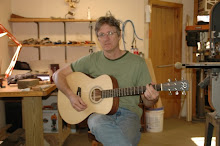
| It works! There’s a happy guy. |
 |  |
| Tom got his going after lunch. | Jon had his strings on by the end of Thursday. |
 |  |
| Brennan strings his OOO by the afternoon. | A tired but determined Lynn picks out a tune. |
 |
| Adam rocks out on the tenor guitar!! |
I must say that all of the guitars sounded loud and even across the full range of the instrument. The bass was resonant – I could really feel it in the body. The highs were ringing. I still can’t believe how good it sounds and how playable it is. I keep picking up one of the other guitars I have (the Martins or Collings) for comparison and to me, my new guitar compares favorably to those. Of course, fresh guitar will only get better over time and I can already hear it changing as it settles in. Time will tell.
Now that the strings were on, it was time to take it all apart again! There was more finish work to do. For instance, after getting the saddle intonation exactly right, you had to file it and sand it. Also, I still needed to do my inlay and get a first coat of tru-oil on the back and sides. However, there was certainly light at the end of the tunnel and I knew we would all have playable guitars from this adventure. I spent another night in the shop to finish cutting my inlay so I would be ready to do it on Saturday morning before the course was officially over. I think everyone was in the shop until about 10:30 p.m. doing various finishing activities.
 |
My guitar back in pieces. You can see the inlay cutting jig in the vise in the foreground. |
On Saturday, I started the inlay process. It took me four hours, but I’m glad I did it for the experience – plus, it turned out really well. I can see why some folks don’t necessarily like to do the inlay part, although I enjoyed it. You use a jewelers saw to move the piece through the pattern you are cutting, keeping the saw moving up and down at a steady pace. It’s not hard to do, but it is time-consuming, Like other parts of guitar building, this one cannot be rushed. That’s why I cut the inlay over the course of a few nights instead of all at once.
A good tip from George was to make sure that the inlay cut was perfectly, because that’s what will show up on the guitar. Any mishits with the router when cutting the channel could be filled in with epoxy or superglue/ebony dust. I spent an hour or more of sanding and filing on Saturday to get the edges straight and true on the one hand and curvy on the other hand. No jaggies for me at this point. Using the dremel router to cut the channel was challenging but certainly do-able if you didn’t rush it.
 |  |
| Inlay outline on the guitar headstock. | Channel routed in the headstock at the right depth. |
 |  |
| Mother of pearl inlay with epoxy. | And after sanding the epoxy. |
When I had finally got the inlay done, I could put it all together again before heading back to Boston. There was no way I was going home with a guitar in a bunch of pieces.
 |
| Back together again and one tired builder. |
I had to pack quickly and get going because we had BSO tickets that night. I said my good-byes, got my case, and made one last stop at Baker’s for snacks for the ride. I had a million thoughts running through my head as I drove back to Massachusetts, reflecting on the weeks that suddenly had just come to a close.
I made it home by 5:30 p.m. after an exhausting, exhilarating, exciting, energizing, and intense experience. It was a great group to work with and excellent teachers in Adam and George.
 |
| Tom, Jon, George, Brennan and sculpture, Adam, Chris, Lynn. |
Next up, an epilogue with final thoughts.
Chris
Subscribe to:
Posts (Atom)